HLISTIX

Clinical Intelligence for Chinese Medicine.

So the work around the treatment doesn't become a second shift.

From anamnesis to the patient treatment summary, the clinical context stays connected.

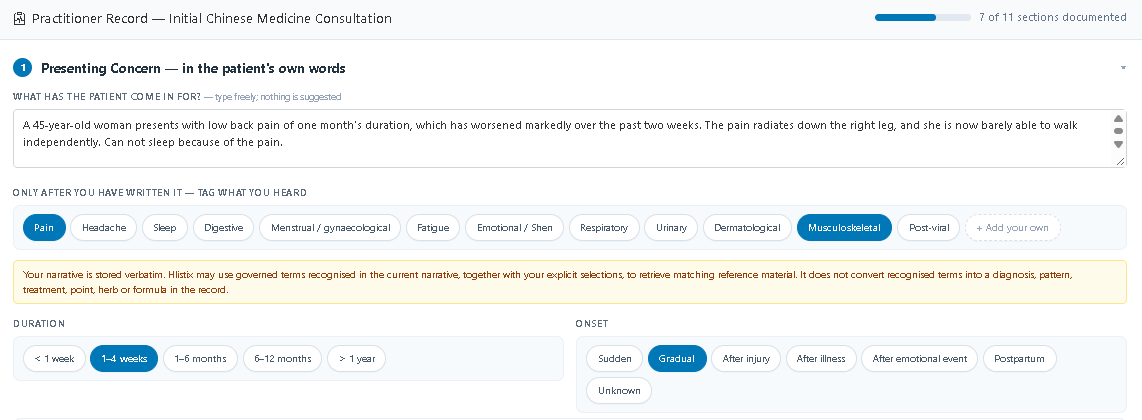
The Chinese Medicine Treatment Summary: the presenting concern in the patient's own words, the tags the practitioner selected, duration, onset, and Inquiry, the Ten Questions A 45-year-old woman presents with low back pain of one month's duration, which has worsened markedly over the past two weeks. The pain radiates down the right leg, and she is now barely able to walk independently. Can not sleep because of the pain.

Clinical intelligence

Questions to Complete the Anamnesisresearch-informed
  • 寒熱 Cold & HeatIs the pain eased by warmth, or worse in cold, damp weather?OpenRecorded ✓
  • 頭身 Head & BodyIs the pain heavy, fixed, or moving from place to place?OpenRecorded ✓
  • 睡眠 SleepDoes the pain wake her, or is it hard to fall asleep?Open
  • 小便 UrinationAny frequent urination at night?Open
Biomedical Context & Safety3 warning signs to review
Pattern Differentiationlinking your findings

Real HLISTIX interface. Synthetic demonstration case, not a real patient.

Built on evidence. Designed to keep the practitioner in control.

  • 526,320Published research records
  • 9,034Unique journals
  • Sources visibleBeside the information
  • You decideHLISTIX informs. You make the professional decision.
  • Chinese Acupuncture & Moxibustion
  • Acupuncture Research
  • Acupuncture in Medicine
  • Medical Acupuncture
  • Journal of Acupuncture and Meridian Studies
  • Evidence-Based Complementary and Alternative Medicine
  • Complementary Therapies in Medicine
  • BMC Complementary Medicine and Therapies
  • BMC Complementary and Alternative Medicine
  • Journal of Alternative and Complementary Medicine
  • Complementary Therapies in Clinical Practice
  • Journal of Integrative and Complementary Medicine
  • Integrative Medicine Research
  • Chinese Journal of Integrative Medicine
  • Journal of Integrative Medicine
  • Journal of Traditional and Complementary Medicine
  • Journal of Traditional Chinese Medicine
  • Chinese Medicine
  • The American Journal of Chinese Medicine
  • Phytomedicine
  • Phytotherapy Research
  • Integrative Cancer Therapies
  • Global Advances in Integrative Medicine and Health
  • Journal of Ayurveda and Integrative Medicine
  • Journal of Evidence-Based Integrative Medicine
  • Pain
  • The Journal of Pain
  • Pain Medicine
  • Journal of Pain Research
  • Frontiers in Pain Research
  • Journal of Pain and Symptom Management
  • The Journal of Headache and Pain
  • Clinical Rheumatology
  • Rheumatology
  • Arthritis Care & Research
  • Archives of Physical Medicine and Rehabilitation
  • Journal of Rehabilitation Medicine
  • Sleep Medicine
  • Journal of Clinical Sleep Medicine
  • Nutrients
  • The Journal of Nutrition
  • Frontiers in Nutrition
  • World Journal of Gastroenterology
  • The American Journal of Gastroenterology
  • Neurogastroenterology and Motility
  • Frontiers in Psychology
  • Frontiers in Psychiatry
  • Journal of Psychiatric Research
  • Psychological Medicine
  • Psychosomatic Medicine
  • Nature Medicine
  • BMJ Open
  • PLOS ONE
  • Scientific Reports
  • JAMA Internal Medicine
  • JAMA Network Open
  • EClinicalMedicine
  • The Lancet
  • Annals of Internal Medicine
  • Journal of Clinical Medicine

Journal names show where research in the corpus was published. They do not indicate partnership, sponsorship or endorsement of HLISTIX.

Around one case

12 specialized research assistants. One clinical context.

They sit inside the Treatment Summary, around the case you are working on. Each one responds to what you document and select, and surfaces information for your review. None of them makes the clinical decision. Open any assistant to see what it brings to this case.

The Chinese Medicine Treatment Summary record for the synthetic case: presenting concern, tags, duration, onset and the Ten Questions

Clinical intelligence

  • 寒熱 Cold & HeatIs the pain eased by warmth, or worse in cold, damp weather?
  • 小便 UrinationAny frequent urination at night?
  • Saddle anaesthesia or new bladder / bowel changeSource criterion · not recorded in this case
  • Progressive leg weakness or foot dropSource criterion · not recorded in this case
  • Cold-Damp Bi 寒濕痹Your findings: aversion to cold · heavy, cramping pain · worse with cold · better with warmth · tight pulse
  • Qi and Blood stagnation in the channelsYour findings: pain radiating along the leg

Possible patterns · source order, no ranking · you choose

Chinese medicine reference

風寒濕三氣雜至,合而為痹也。

"Wind, cold and dampness arrive together and combine to form bì."

Huángdì Nèijīng Sùwèn · ch. 43, Bì Lùn

BL40 Wěizhōng 委中 · BL23 Shènshū 腎俞 · GB30 Huántiào 環跳 · location, atlas, traditional indications

Dú Huó 獨活 · Sāng Jì Shēng 桑寄生 · Guì Zhī 桂枝 · actions, cautions

Dú Huó Jì Shēng Tāng 獨活寄生湯 · Bèi Jí Qiān Jīn Yào Fāng

Warming foods where cold predominates; fewer cold, raw foods · for your review

Moxibustion · Cupping · Gua sha · Tuina

Research & professional guidance

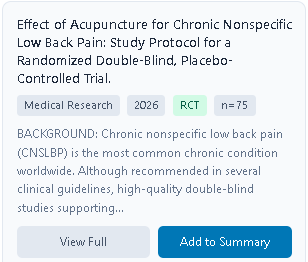
A study card: acupuncture for chronic non-specific low back pain, with year, design (RCT) and sample size
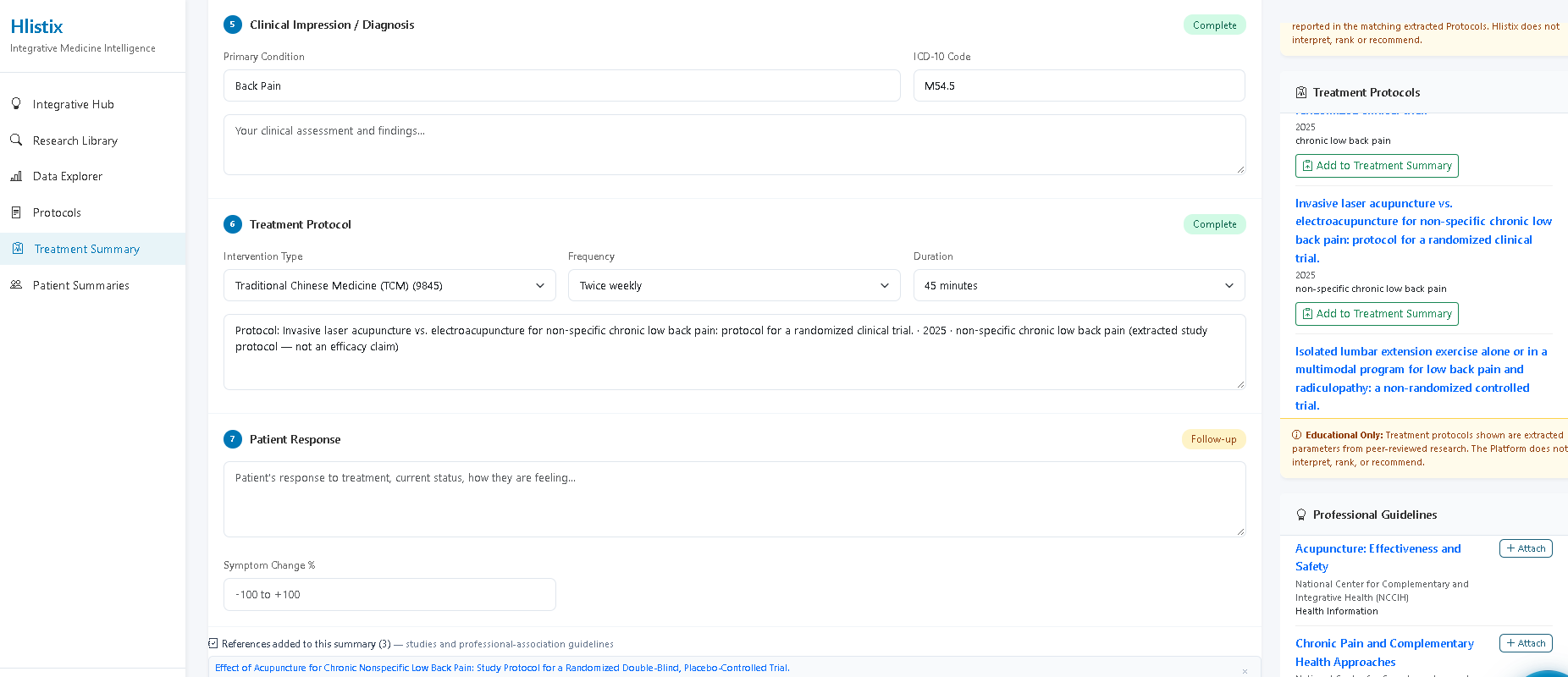
A treatment protocol extracted from published research on chronic low back pain, with Add to Treatment Summary

Frequency, sessions and duration as reported in the study · not HLISTIX recommendations

A professional guideline from a national health agency, with Attach and its source
Real HLISTIX record screen, synthetic demonstration case.
  1. You document or select in the Treatment Summary
  2. The assistants respond to that case context
  3. You review the information and its source
  4. You decide what, if anything, enters the record

They surface relevant knowledge around the case. You decide what belongs in the treatment.

The product

One case. The Chinese medicine clinical workflow.

The Chinese Medicine Treatment Summary follows the way you already work: the four examinations, safety, pattern differentiation, treatment planning, treatment and its evaluation. As you document on the left, the assistants respond on the right.

Built around the professional workflow reflected in the 2026 NCBAHM Exam Content Outlines. HLISTIX is an independent platform and is not affiliated with, endorsed by, or certified by NCBAHM.

01 · Patient assessment · Inquiry 問

Start with the case, and make the anamnesis easier to deepen.

As you document the presenting concern and the Ten Questions, HLISTIX surfaces research-informed questions for the categories that are still open, and marks them recorded as you answer.

Research-derived questions help practitioners explore topics and considerations reported in the published literature. They are presented for education and reference and are not diagnostic questions, a clinical assessment, or a treatment recommendation.
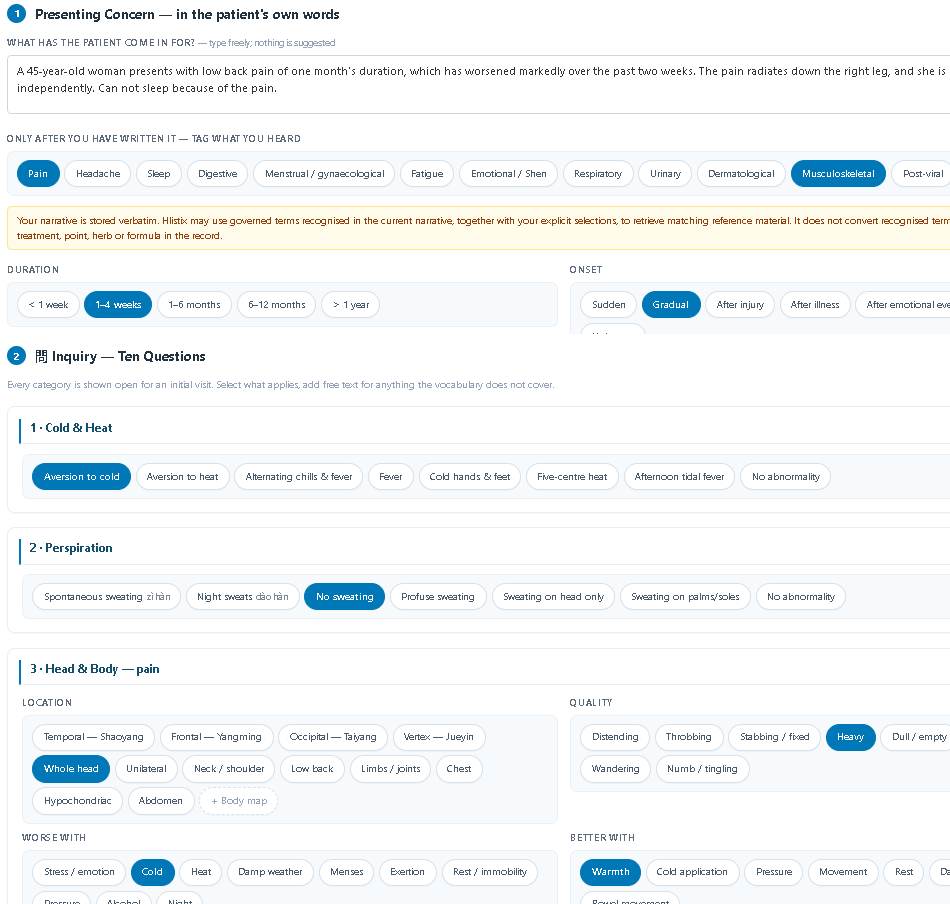
Inquiry, the Ten Questions: Cold & Heat, Perspiration and Head & Body, with the practitioner's selections

Clinical intelligence

Questions to Complete the Anamnesis4 open · research-informed
  • 寒熱 Cold & HeatIs the pain eased by warmth, or worse in cold, damp weather?OpenRecorded ✓
  • 汗 PerspirationAny spontaneous sweating, or night sweats?OpenRecorded ✓
  • 頭身 Head & BodyWhere exactly is the pain, and is it heavy, fixed or moving?OpenRecorded ✓
  • 小便 UrinationAny frequent urination at night?Open
Real HLISTIX record screen, synthetic demonstration case.
02 · Patient assessment · Observation, tongue, pulse & palpation 望聞切

Record the examination in the terms you were trained in.

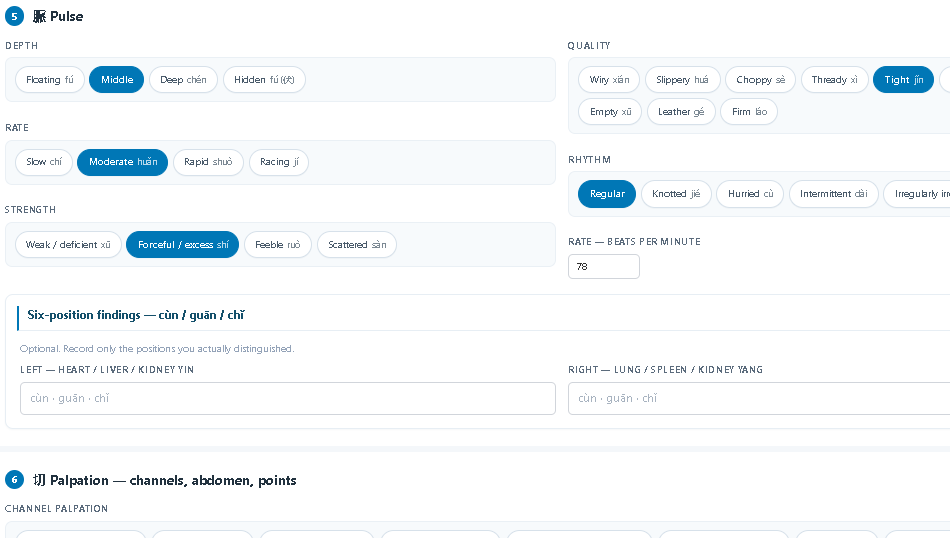
Shen, complexion, tongue, pulse depth, rate, strength, quality and rhythm, six-position findings and channel and abdominal palpation, as structured selections. Each finding you record is linked to the patterns it relates to, beside the case.

You record only what you actually observed. Nothing is pre-filled.

Pulse: depth, rate, strength, quality and rhythm with the practitioner's selections (middle, moderate, forceful, tight, regular, 78 beats per minute), six-position findings and channel palpation 78

Clinical intelligence

Pattern Differentiationfindings linked as you record

Your findings so far

  • Aversion to cold
  • Heavy pain
  • Worse with cold
  • Better with warmth
  • Forceful pulse
  • Tight pulse 緊

Possible patterns · source order, no ranking

  • Cold-Damp Bi 寒濕痹Linked: aversion to cold · heavy pain · worse with cold · tight pulse
  • Qi and Blood stagnation in the channelsLinked: pain radiating along the leg
Real HLISTIX record screen, synthetic demonstration case.
03 · Safety & biomedical context

Bring biomedical context and safety into the same clinical picture.

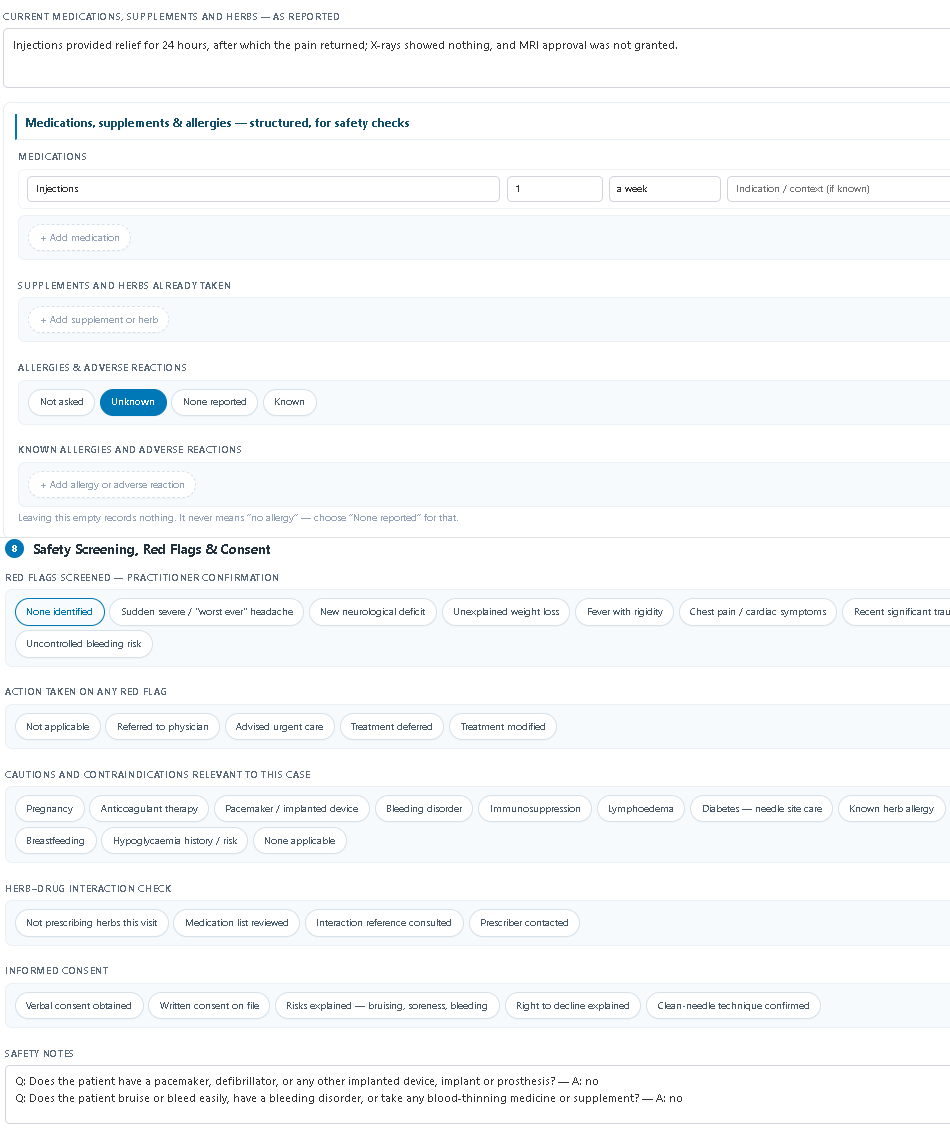
Medications, supplements and herbs already taken, allergies, red flags screened, cautions and contraindications, the herb–drug interaction check and informed consent, beside the Chinese medicine case. Warning signs from the sources appear for your review.

Warning signs are criteria from their sources. You remain responsible for assessment and clinical action.

Current medications as reported, structured medications, allergies, and Safety Screening, Red Flags and Consent with the practitioner's confirmations Injections provided relief for 24 hours, after which the pain returned; X-rays showed nothing, and MRI approval was not granted.

Clinical intelligence

Biomedical Context & Safetywarning signs to review
  • Saddle anaesthesia or new bladder / bowel changeSource criterion · not recorded in this case
  • Progressive leg weakness or foot dropSource criterion · not recorded in this case
  • Fever, unexplained weight loss, history of cancerSource criterion · not recorded in this case
  • Injections, as reportedCheck the medication list before considering herbs
Real HLISTIX record screen, synthetic demonstration case.
04 · Pathomechanisms & pattern differentiation

Move from findings to your own pattern differentiation.

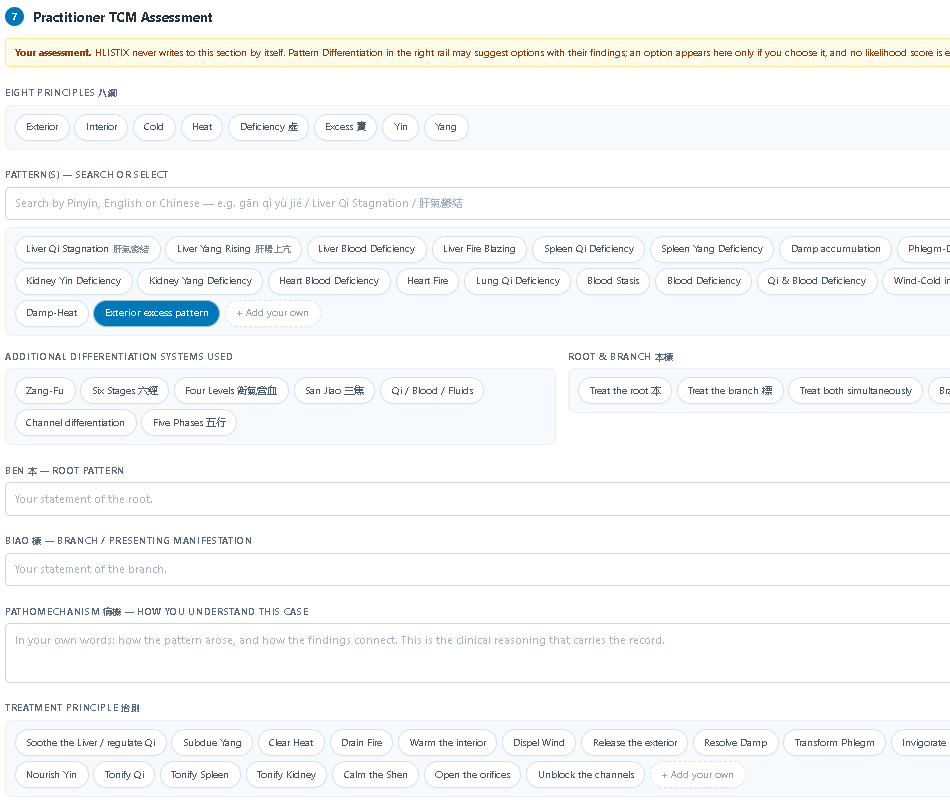
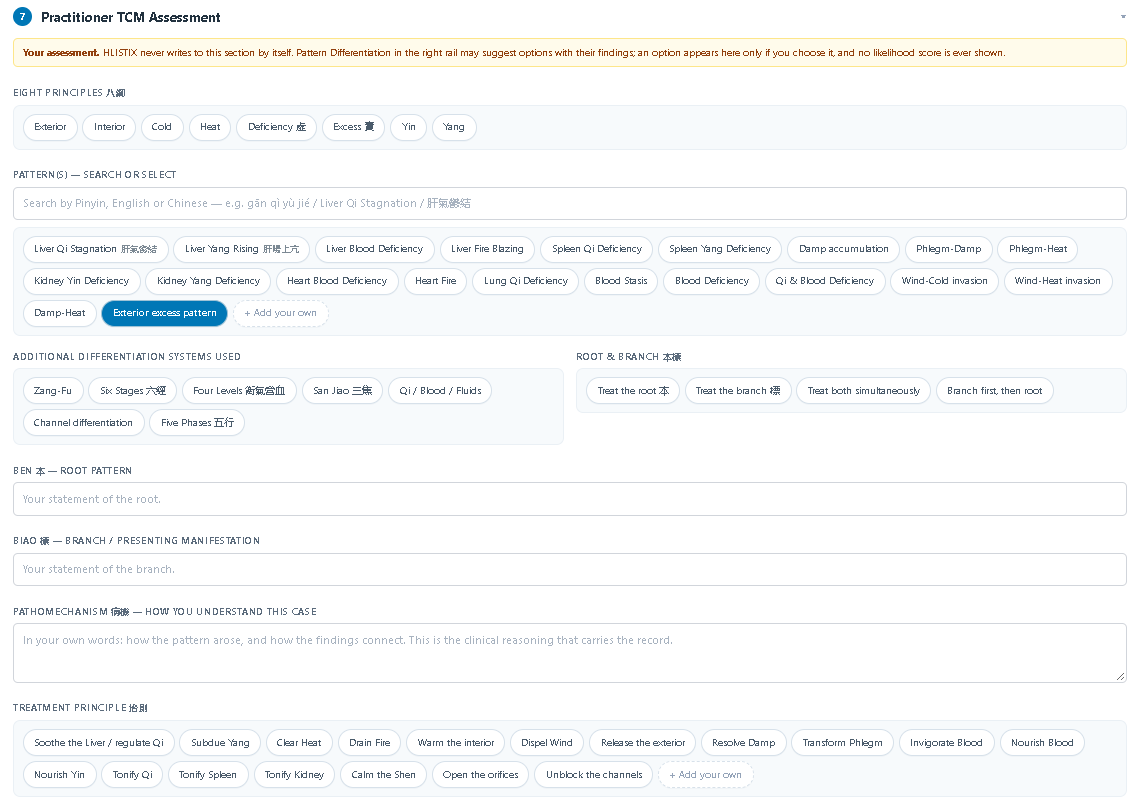
Eight Principles, patterns, additional differentiation systems, root and branch, your pathomechanism and the treatment principles. Pattern Differentiation shows possible patterns with the findings they relate to; a pattern enters your assessment only when you choose it.

HLISTIX never writes to your assessment by itself, and no likelihood score is ever shown.

Practitioner TCM Assessment: Eight Principles, pattern selection, additional differentiation systems, root and branch, pathomechanism and treatment principles Cold and damp lodge in the channels of the lower back and right leg and obstruct Qi and Blood: the pain is heavy, fixed and cramping, worse with cold and better with warmth.

Clinical intelligence

Pattern Differentiationpossible patterns · no ranking
  • Cold-Damp Bi 寒濕痹Your findings: aversion to cold · heavy, cramping pain · worse with cold · better with warmth · tight pulseChooseChosen ✓
  • Qi and Blood stagnation in the channelsYour findings: pain radiating along the legChoose
  • Kidney deficiencyNeeds more context: not enough recorded yet

Chinese medicine reference

Classical & Traditional Sources6 passages
風寒濕三氣雜至,合而為痹也。

"Wind, cold and dampness arrive together and combine to form bì."

Huángdì Nèijīng Sùwèn · ch. 43, Bì Lùn

Real HLISTIX record screen, synthetic demonstration case.
05 · Treatment planning & techniques

Bring the treatment options around the same case.

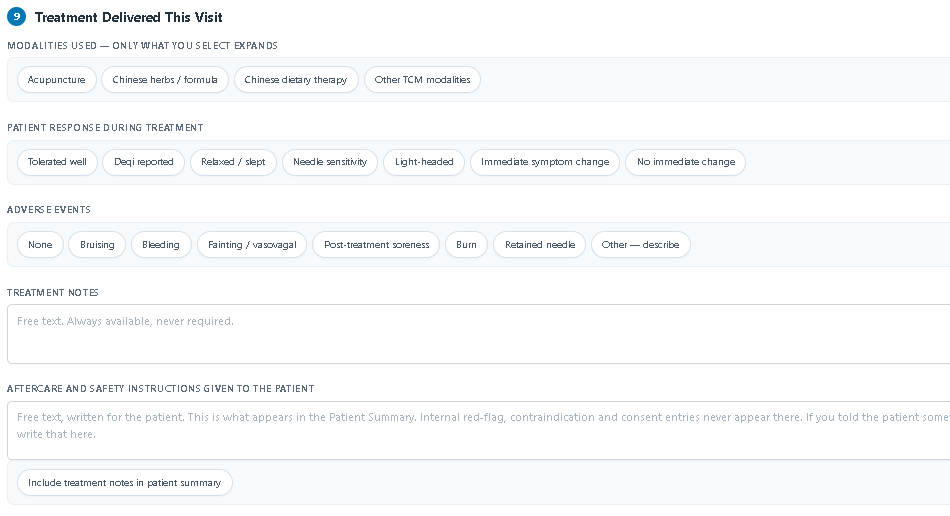
Select the modalities you use, and the matching references open beside the case: acupuncture points and the atlas, Chinese herbs, herbal formulas, Chinese dietetics and other tools such as moxibustion and cupping, each with its source and cautions.

Reference information for your review. HLISTIX does not prescribe, select or dose a treatment.

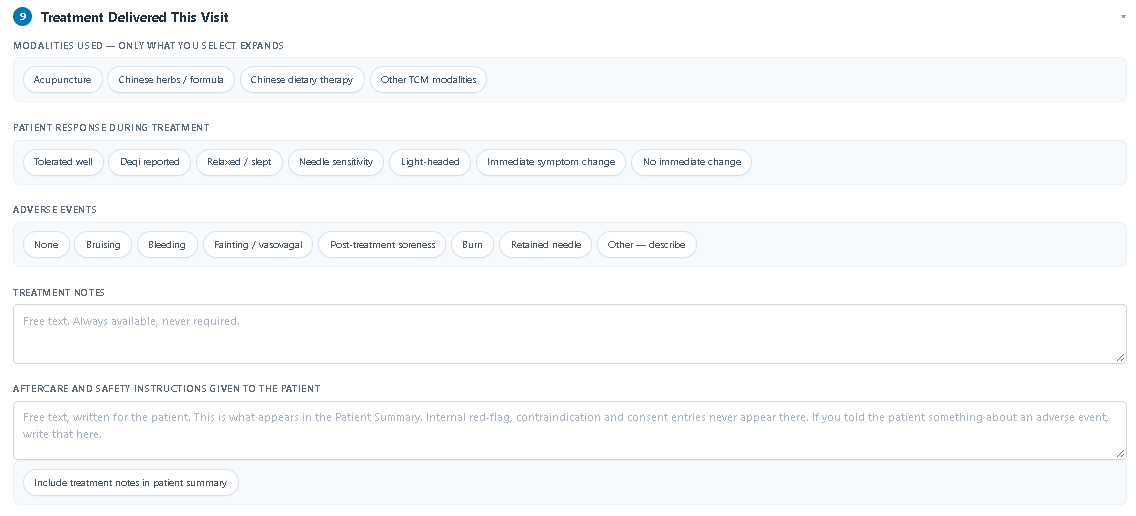
Treatment Delivered This Visit: modalities used, patient response during treatment, adverse events, treatment notes and aftercare instructions Points chosen by the practitioner; moxibustion over the lower back; 25 minutes retention.

Chinese medicine reference

Acupuncture Points & Atlas6 points

BL40 Wěizhōng 委中 · BL23 Shènshū 腎俞 · GB30 Huántiào 環跳 · location, atlas, traditional indications

Chinese Herbs10 shown

Dú Huó 獨活 · Sāng Jì Shēng 桑寄生 · Guì Zhī 桂枝 · actions, cautions

Herbal Formulas8 shown

Dú Huó Jì Shēng Tāng 獨活寄生湯 · Bèi Jí Qiān Jīn Yào Fāng

Chinese Dieteticsconsiderations

Warming foods where cold predominates; fewer cold, raw foods

Other Chinese Medicine Tools4 for this case

Moxibustion · Cupping · Gua sha · Tuina

Real HLISTIX record screen, synthetic demonstration case.
06 · Research, protocols & professional guidelines

Current research, published protocols and professional guidance, beside the plan.

Three different evidence and reference layers, each with its source, beside the plan. Not one mixed AI answer.

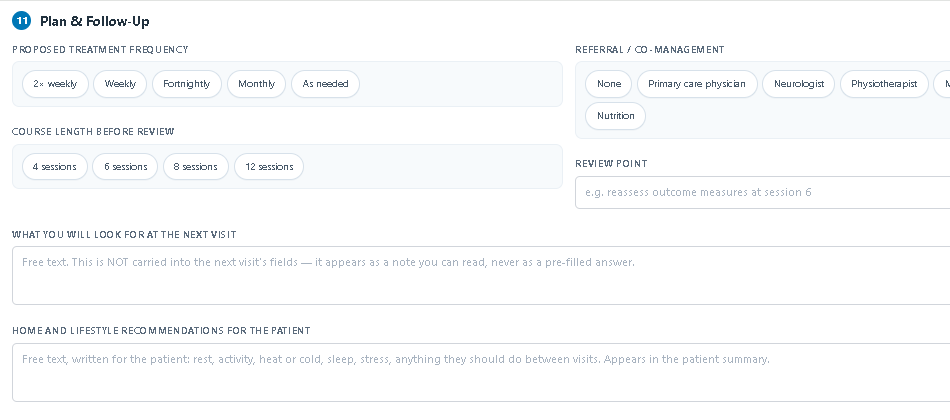
Plan and Follow-Up: proposed treatment frequency, course length before review, referral, review point and what to look for at the next visit Reassess pain and walking distance at session 6

Research & professional guidance

Current Research12 studies
A study card: acupuncture for chronic non-specific low back pain, with year, design (RCT) and sample size

View Full · Add to SummaryAdded to the summary's references ✓

Extracted Protocolsfrequency · sessions · duration
A treatment protocol extracted from published research on chronic low back pain, with Add to Treatment Summary
Professional Guidelines & Board Scope2 guidelines
A professional guideline from a national health agency, with Attach and its source
Real HLISTIX record screen, synthetic demonstration case.

Current research

When published studies report outcomes, those findings show what study populations experienced. They can help you frame realistic expectations with a patient.

Study findings describe populations; they do not predict an individual patient's outcome.

Published protocols

  • Treatment frequency
  • Number of sessions
  • Treatment duration
  • Other reported parameters

A reference point when you discuss what a course of care may involve.

Parameters reported in published research, not HLISTIX treatment recommendations.

Professional guidelines

Professional and public-health guidance as its own layer, with the issuing organization and the source shown.

07 · Treatment evaluation & follow-up

The record and the follow-up take shape during the visit.

Outcome measures recorded again at every visit, what you will look for next time, the instructions written for the patient and the references you added, with their source links. When you finish, the patient summary is generated from your record.

The Treatment Summary provides a flexible workspace for practitioners to organize and document information according to their own professional approach. Practitioners choose what information to record, which sections are relevant, and how to use the workspace.

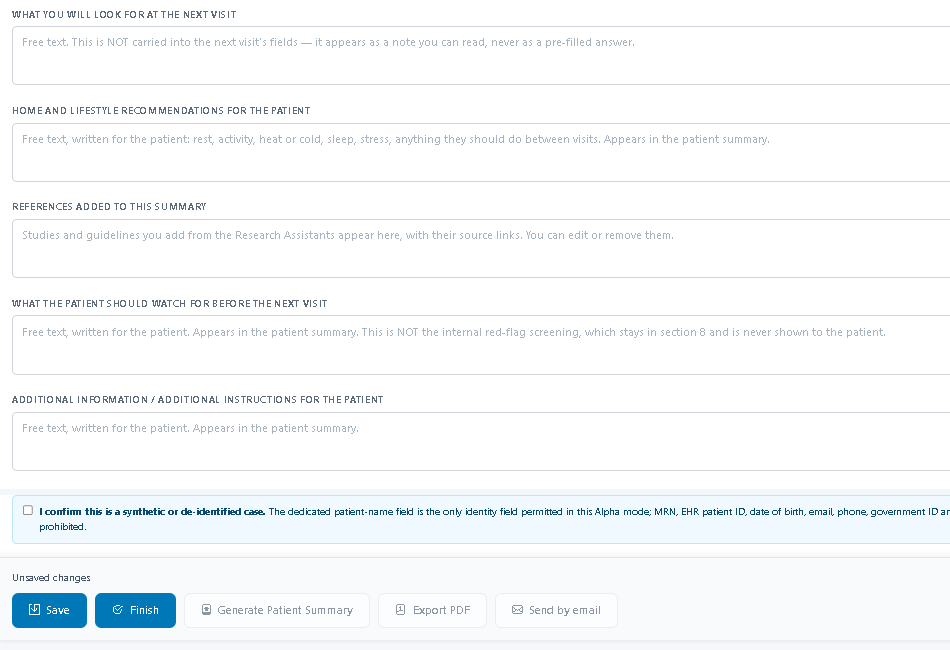
Plan and Follow-Up: what to look for at the next visit, home and lifestyle recommendations for the patient, references added to the summary, instructions for the patient, and the Save, Finish and Generate Patient Summary buttons Walking distance, sleep, and whether the leg pain has receded toward the lower back. Keep the lower back warm; gentle walking every day; avoid sitting on cold, damp ground. Sùwèn ch. 43, Bì Lùn · Acupuncture for chronic non-specific low back pain, RCT protocol (2026) · NCCIH, Acupuncture: Effectiveness and Safety

Patient summary

Patient Visit Summary · Visit 1draft · not sent

What we did todayAcupuncture and moxibustion for low back pain radiating to the right leg.

What to expectWeekly sessions; we will review your progress at session 6.

Between visitsKeep the lower back warm and walk gently every day.

Review, edit and approve before anything is sent.

Real HLISTIX record screen, synthetic demonstration case.

You remain the decision-maker.

  1. SurfaceHLISTIX can surface relevant information.
  2. ReviewYou review the source and its relevance.
  3. Add or leave outYou choose whether it belongs in the Treatment Summary.
  4. Edit or write your ownEdit it, ignore it completely, or document your own assessment and treatment plan in free text.

Nothing becomes your clinical decision until you make it one. HLISTIX informs. The practitioner decides.

Classical and contemporary

Classical Chinese medicine and contemporary evidence, around the same case.

Chinese medicine practitioners often work across knowledge systems that were never designed to sit together. HLISTIX brings those layers around the same patient context without flattening their differences.

  • Classical & traditional Chinese medicine

    Relevant passages and traditional source material, with provenance visible.

  • Chinese medicine reference knowledge

    Points, herbs, formulas, dietetics and other tools, with identifiable source information.

  • Contemporary research

    Modern studies and reported findings, including research conducted in contemporary and Western populations where available.

  • Published protocols

    Treatment parameters reported in published studies.

  • Professional guidance

    Relevant professional and public-health guidance, where available.

  • Different approaches, side by side

    See where sources, traditions or professional approaches converge, and where they differ.

Classical Chinese medicine and contemporary evidence, without forcing you to choose one information world or the other.

For the patient

From the clinical record to a patient-ready summary in seconds.

Generate the patient treatment summary in seconds from the record you have already built during the visit.

  1. Generate
  2. Review
  3. Edit
  4. Approve
  5. PDF · Print · Email

It can include

  • Your clinic logo
  • Your digital signature
  • Guidance you approve
  • Next steps
  • The treatment process, explained

You review, edit and approve every word, then export a PDF, print it, or email it with the patient's consent. Nothing is sent automatically.

Save, Finish, Generate Patient Summary, Export PDF and Send by email on the Chinese Medicine Treatment Summary.
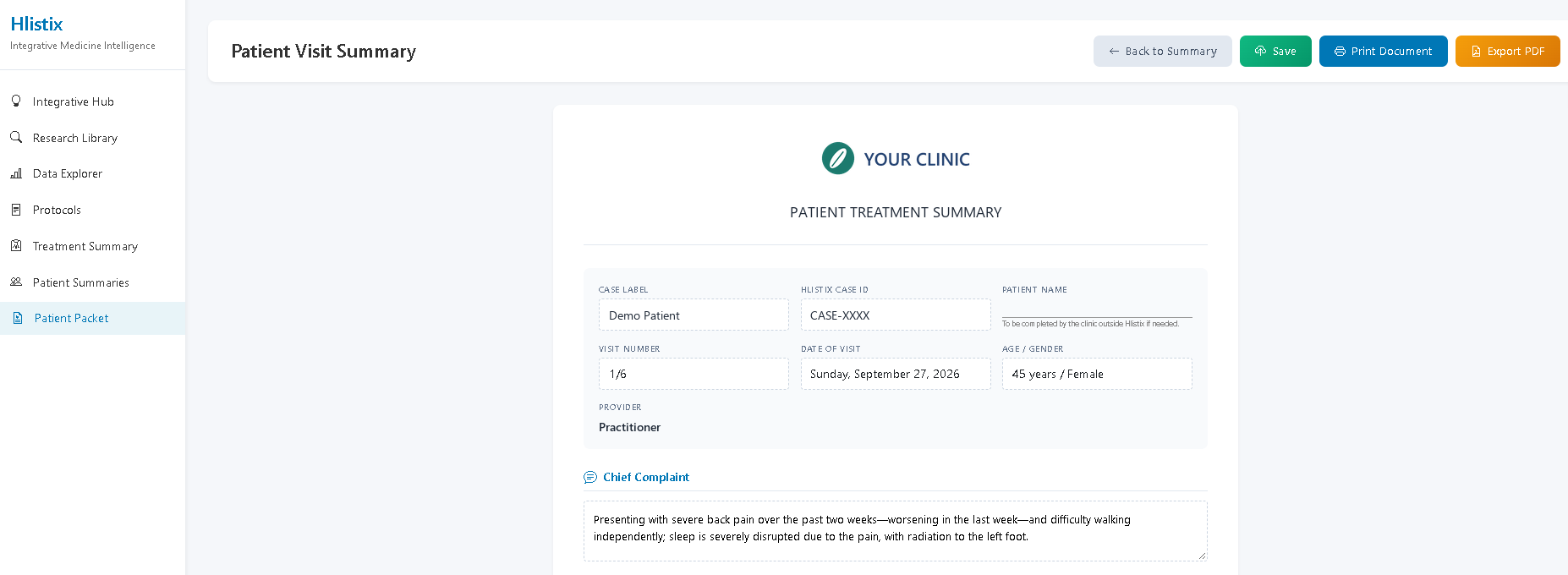
Patient treatment summary with the clinic's logo: visit number, date and chief complaint (demonstration values)
A patient treatment summary, generated from what was documented during the visit (demonstration case).

The treatment summary gives you a clear way to explain the treatment journey, using the research, protocols and professional guidance already connected to the case. It can communicate:

  • What happened today What was addressed in this visit.
  • The expected process What a course of treatment may involve.
  • Why it takes several visits When a course of treatment needs more than one session.
  • Progress so far Where the patient is relative to the treatment plan you set.
  • What supports it Research, protocols or professional guidance behind the process.
  • What comes next The next stage, so the patient knows what to expect.
  • Between visits Practical guidance you choose and approve, so the patient can take part in their own progress.

You select and approve everything the patient receives.

Instead of the patient leaving with a conversation to remember, they leave with a clear summary and a clear next step.

Summaries are sent by email only to patients who have consented to email.

Practical value

Built around the way practitioners actually work

  1. Prepare
  2. Assess
  3. Differentiate
  4. Plan
  5. Treat
  6. Document
  7. Follow up
  8. Communicate
  • The presenting concern in the patient's own words, with the tags the practitioner selected

    Prepare for a case

    The presenting concern, the Ten Questions and research-informed questions to ask, in one place.

    Outcome Relevant clinical context is already connected.

  • Eight Principles and pattern selection in the Practitioner TCM Assessment

    Assess and differentiate

    Safety, pulse and palpation findings and your own pattern differentiation, in the same record.

    Outcome Less switching between disconnected references, tools and notes.

  • Treatment Delivered This Visit: modalities, patient response and adverse events

    Plan, treat and document as you work

    Points, herbs, formulas and dietetics beside the case; treatment delivered recorded during the visit.

    Outcome Less reconstruction after the visit.

  • Patient treatment summary with visit number and details

    Help patients understand the treatment journey

    Use research, protocols and professional guidance to set clear expectations: what the process may involve, where the patient is in it, what progress has occurred, and what comes next.

    Outcome Clearer continuity and stronger patient understanding.

  • Save, Finish, Generate Patient Summary, Export PDF and Send by email

    Follow up and keep the patient engaged between visits

    Plan the follow-up, then review the summary and send it to the patient: what was addressed, next steps, and guidance you approve for between visits.

    Outcome The patient leaves with something concrete and a clear next step.

The work around the treatment

Chinese medicine shouldn't require rebuilding the same case across ten different information worlds.

Today

  • Classical texts
  • Modern Chinese medicine references
  • Acupuncture references
  • Materia medica
  • Formula references
  • Dietetics
  • Biomedical information
  • Research databases
  • Published protocols
  • Professional guidelines
  • Notes and documentation
  • Patient communication

The hidden work, every time

  1. Find
  2. Translate
  3. Rebuild context
  4. Compare
  5. Document
  • Research after hours
  • Rebuilding the case in every tool
  • Checking sources one by one
  • Writing up the visit later
  • Creating patient explanations separately

With HLISTIX

The case
  • Classical & Traditional Sources
  • Chinese Medicine Reference
  • Biomedical & Safety
  • Contemporary Research
  • Published Protocols
  • Professional Guidance
  • Documentation
  • Patient Communication

The case stays in the middle. The knowledge you review, the decisions you document and the information the patient receives stay connected around it.

A chat window gives you an answer. HLISTIX gives the case a working environment.

Research & Sources

See where the knowledge comes from, whether it is classical or contemporary.

Modern evidence

526,320Published research records

9,034Unique journals

  • Study title, year, design and sample size on every study
  • The full record, one click away
  • Each protocol with the study it was reported in
  • Each guideline with its issuing organization

Chinese medicine sources

  • Classical passages with their provenance
  • Original terminology where available, with translation
  • An identifiable source for every passage
  • Multiple traditions, where available
  • Differences between sources stay visible rather than being silently merged

HLISTIX should not ask practitioners to trust a black box. Source-based information remains reviewable. How HLISTIX handles sources, privacy and safety

Keep the system that runs your clinic. Add the workspace that supports the clinical work.

Your practice-management system

Scheduling, billing, payments and appointment administration. HLISTIX does not replace it.

HLISTIX

The clinical intelligence layer around the case: assessment, Chinese medicine knowledge, evidence, documentation and the patient summary.

Pricing

Try it in real clinical work.

The best way to understand HLISTIX is to use it with your own cases. Both plans start with a 14-day trial.

  • Research-derived questions, research, protocols and professional guidance around each case
  • Sources visible beside every study
  • Structured visit documentation
  • Patient treatment summaries with your logo and signature

Prices in U.S. dollars. For qualified practitioners; the practitioner plan includes a short credential verification.

FAQ

Questions practitioners ask

What is HLISTIX?

HLISTIX is a clinical intelligence workspace for Chinese medicine and acupuncture practitioners. Around one case, it brings 12 research assistants: questions to complete the anamnesis, biomedical context and safety, pattern differentiation, classical and traditional sources, acupuncture points, herbs, formulas, dietetics and other Chinese medicine tools, current research, published protocols and professional guidelines, together with your documentation and the patient treatment summary. It is for education and professional reference: it supports, but does not replace, your independent clinical judgment.

Does HLISTIX make clinical decisions?

No. HLISTIX informs; you make the professional decision. It does not diagnose, prescribe, select treatment or direct patient care. You review the sources and decide what, if anything, enters the treatment summary.

Is HLISTIX only for complex cases?

No. HLISTIX supports the everyday work of a visit: the anamnesis, the documentation and the summary the patient takes home. Complex and chronic cases simply create more work around research and documentation, so the difference may show sooner there.

Where does the research come from, and can I see the sources?

Modern research comes from 526,320 published research records in 9,034 unique journals. Every study shows where it comes from: title, year, study design and sample size, and you can open the full record to judge it yourself. Classical and traditional passages carry their provenance too.

Does HLISTIX include classical Chinese medicine sources?

Yes. The Classical & Traditional Sources assistant surfaces relevant passages from classical and traditional Chinese medicine sources, with provenance visible, beside modern research, published protocols and professional guidance for the same case.

Does HLISTIX choose points, herbs or formulas for me?

No. The points, herbs, formulas, dietetics and other tool assistants surface reference information, with its source and any listed cautions, around the findings you recorded. You decide what applies; HLISTIX does not prescribe, select or dose a treatment.

Are the protocols HLISTIX treatment recommendations?

No. Protocols are treatment parameters, such as frequency, number of sessions and duration, as reported in published research, presented for educational review. HLISTIX does not interpret, rank or recommend them.

What are the 12 research assistants?

Twelve specialized layers of information around the case: Questions to Complete the Anamnesis, Biomedical Context & Safety, Pattern Differentiation, Classical & Traditional Sources, Acupuncture Points & Atlas, Chinese Herbs, Herbal Formulas, Chinese Dietetics, Other Chinese Medicine Tools, Current Research, Extracted Protocols, and Professional Guidelines & Board Scope. Each responds to what you document and select in the Treatment Summary; none of them makes a clinical decision.

How is HLISTIX different from ChatGPT, Claude or Gemini?

A general AI tool starts with a prompt, and the case usually has to be described again each time. HLISTIX starts with the case: the clinical context stays connected, the information surfaced around it carries its source, and the documentation develops in the same workflow.

Does HLISTIX replace my EHR or practice-management system?

No. Keep using your current system for scheduling, billing and practice administration. HLISTIX adds the intelligence layer around the clinical work.

What does the patient receive?

A treatment summary that you review, edit and approve, with your logo and digital signature, as a PDF, by email or printed. Nothing is sent without your review, and summaries are emailed only to patients who have consented to email.

Is patient information protected?

Yes. HLISTIX is designed to protect practitioner and patient-related information through security and access-control measures appropriate for professional healthcare workflows. Practitioners may create patient records and practitioner-authored treatment summaries within the platform. HLISTIX's architecture was designed with HIPAA privacy and security requirements in mind to support a future HIPAA-enabled deployment; however, HLISTIX does not currently offer a HIPAA-supported service or enter into Business Associate Agreements with customers. See our Trust & Clinical Use page and Privacy Policy for details.

Do I need to be experienced with AI to use HLISTIX?

No. HLISTIX works inside the clinical workflow you already follow: you document the case, and the relevant information appears beside it.

How does the 14-day trial work?

Choose monthly ($97 / month) or annual ($80 / month, billed $960 a year). Both start with a 14-day trial, so you can use HLISTIX with real clinical work before your first payment.

Who can use HLISTIX?

HLISTIX is built for qualified practitioners. The practitioner plan includes a short credential verification.

See what clinical work feels like when the knowledge is already there.

One case. Chinese medicine knowledge, classical sources, biomedical context, contemporary research, protocols, professional guidance, documentation and patient communication, connected around the work you're already doing.

You remain the clinician. You decide what belongs in the treatment.

The Practitioner TCM Assessment in HLISTIX: Eight Principles, patterns, root and branch, pathomechanism and treatment principles